

Purpose: Protect and promote the U.S.-led capitalist system. A profit-over-people system must be enforced.
Instruments: Military, Espionage, Culture, Finance.
Military
The U.S. ruling class deploys the U.S. military nonstop.
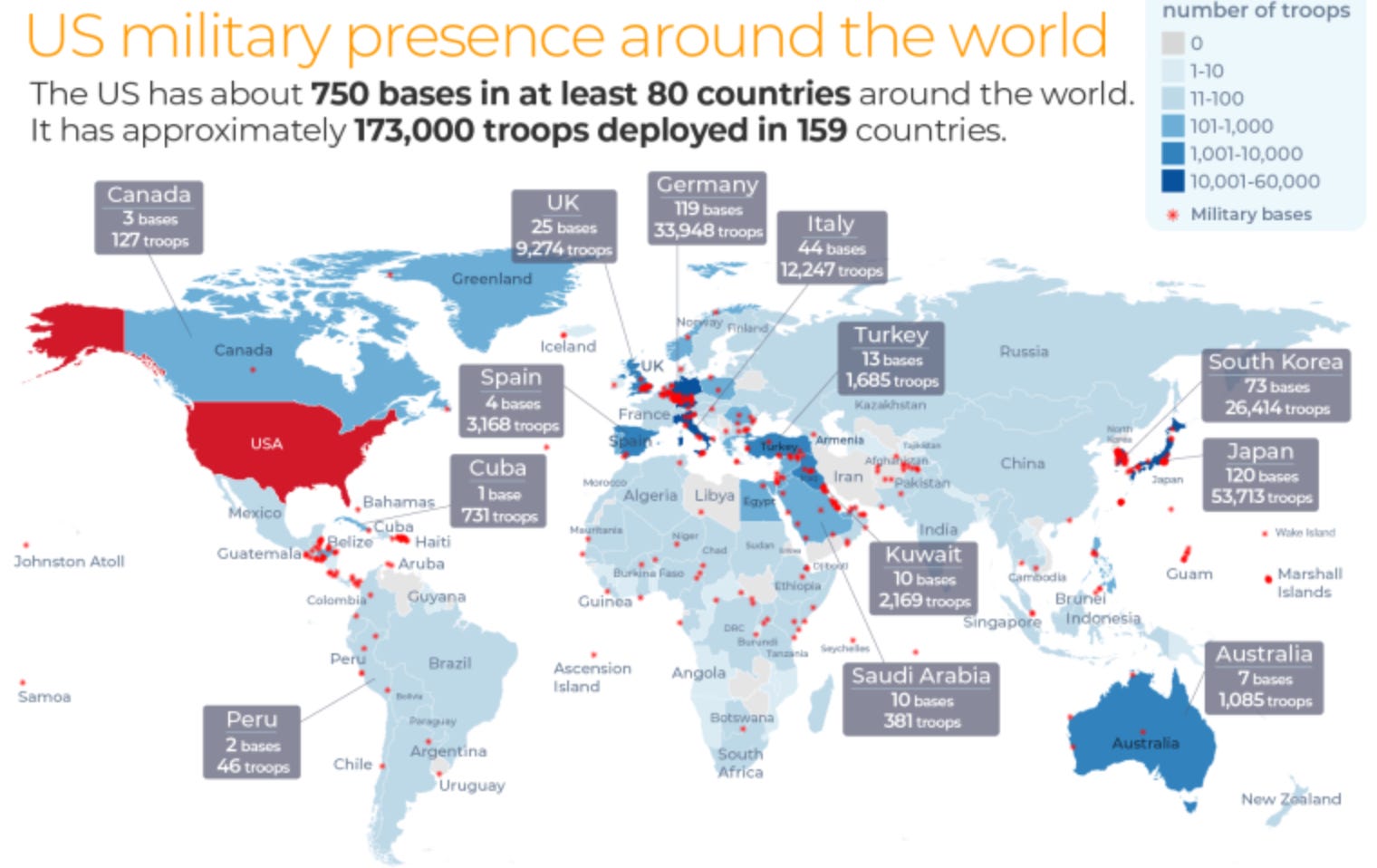
The Pentagon therefore has hundreds of military bases around the world. Over time, big business has become more and more skilled at profiting from military activity itself.
The ruling class does not care about the troops or the broader public. It is the same class that makes sure the U.S. government does not implement universal healthcare, leading to the death of tens of thousands of U.S. citizens and residents every year.

Espionage
The Office of Director of National Intelligence (ODNI) leads a massive bureaucracy that spies on people and allied and independent governments. Different intel agencies have different legal authorities and areas of focus. CIA, for example, takes the lead in propagandizing the workers of the world and recruiting foreigners to spy on their own governments, while NSA/CSS takes the lead in penetrating/protecting electronic communications.
U.S. embassies and consulates function more as espionage strongholds than diplomatic outposts.

U.S. intelligence is also adept at utilizing other countries’ intelligence agencies, especially those of the U.K., Australia, New Zealand, Canada, Jordan, and several Central and Eastern European countries (whose agencies CIA rebuilt and co-opted after the first Cold War, 1917-1991).
Culture
Hollywood films and television series -- not to mention U.S. news programs and sports -- are top U.S. exports. They are designed to distract and discourage independent thought. When they broach the empire once in a blue moon, military life is portrayed inaccurately, espionage activity is largely glamorized, and the reasons behind U.S. foreign policy are not explained.
U.S.-based multinational tech corporations that dominate worldwide internet activity and online cultural production (e.g., Alphabet, Cisco, Meta, Microsoft, Oracle) are not shy about selling to and cooperating with U.S. military and intelligence.1
Finance
Set up during World War II when the U.S. was becoming the economic and military superpower, the World Bank and the International Monetary Fund offer loans to governments around the world. (The U.S. government dominates both institutions through financial contributions and voting power.) The government receiving the loan must enact policies that help multinational corporations plunder its country, including:
opening up state-run sectors (e.g., public transit, agriculture) to foreign investment and control
reducing government spending on public goods (e.g., education, welfare), creating a more fragile workforce
The empire also wages a more direct type of economic warfare. Located within the U.S. Treasury Department, the Office of Foreign Assets Control is in charge of sanctioning groups and people who inconvenience the empire or try to chart an independent path. Such economic sanctions are illegal under international law, mainly because they are collective punishment.
From Cuba to Iran and beyond, the working class of a given country suffers greatly.

Success
So, the U.S. ruling class’ instruments (military, espionage, culture, finance) bully and harm countries and groups that push back against the profit-over-people nature of U.S. foreign policy. The instruments are “successful” when a country (economy, natural resources, and labor) is opened up to multinational corporations and/or a group that has dared to defy Washington gives up.
A few fragile lies sugarcoat U.S. imperialism:
Protect “national security”
Protect and promote “U.S. interests”
Degrade, disrupt, and destroy “terrorists”
Sustain the “rules-based international order”
Ensure a “free and open Indo-Pacific”
Spread democracy
Protect freedom
Politicians, top military officers, and corporate media pundits repeat these lies.
Weaknesses
The empire has many weaknesses. Nine are explained below.
Overextended
Enforcing a profit-over-people system worldwide is a Herculean task. Plenty of free thought and action slip through the cracks.
Drowning
The empire ingests a huge amount of information. U.S. military and intelligence purchase software and computing power from corporations to sort through this information and make sense of it. No amount of technology can remedy the collect-it-all approach and the endless tsunami of information.
Language
The empire targets West Asia (“the Middle East”) and China, but it has a tough time training and retaining competent Arabic and Mandarin linguists:
U.S. personnel learning a Category 4 language at the Defense Language Institute fail for a variety of reasons: laziness; too much partying; and/or a lack of intelligence, aptitude, and humility. Those who do graduate are not always held to a high standard. Examples:
Military linguists can obtain a wavier in order to deploy after failing the language proficiency test. I witnessed this during my time in the military.
Contrary to Hollywood portrayals as multilingual ninjas, CIA case officers regularly need interpreters to accompany them.2
Army Special Forces have very low language standards, which many soldiers do not reach or maintain.
The rare non-native speaker who obtains Advanced Professional Proficiency or Functionally Native Proficiency usually doesn’t stick around. Why? Because the person is exposed to foreign culture, history, and news media when learning the language. Such knowledge deflates the lies with which the linguist grew up (e.g., U.S. foreign policy spreads freedom), leading the linguist to stop serving the empire and seek employment elsewhere.
The empire’s best linguists are typically native speakers who have immigrated to the U.S.
Leadership
Genuine public servants are not allowed anywhere near key leadership positions. What kind of person rises to the top of the empire? Ruthless executives, opportunistic charlatans, and slimy yes-men. Such “leaders” lack the creativity, courage, and heart needed to win against an organized, committed working-class opposition.
Debt
The ruling class directs the U.S. government to spend a lot to sustain the empire. (Military and intel take up the largest single chunk of annual federal discretionary spending.) At the same time, the U.S. government does not make the super-rich and large corporations pay their fair share of taxes. Year after year, the U.S. government spends more than it collects. It makes up for this by borrowing money (selling Treasury securities). U.S. national debt is now over $38 trillion.
This behavior is unsustainable.

Greed: Inferior Products
Capitalists can be their own worst enemy. In their insatiable drive to maximize short-term profit, the executives at large corporations oversee the development of over-budget, under-performing weaponry, such as a ship, a jet, and an aircraft carrier launch system.
Though incredibly profitable for the corporations involved, such subpar weapons hurt the U.S. empire’s ability to project power and bully others.
The Pentagon (captured by corporate interests) does not seriously regulate the war industry, so executives continue to guide the production of mediocre goods and services.
Greed: De-Industrialization
U.S. capitalists have de-industrialized the United States. Sending production overseas (where capitalists can pay workers even less) is done to increase profit, pleasing Wall Street.
While the United States still manufactures weaponry (e.g., missiles, tanks, aircraft, satellites), it does not make some of the basic materials and parts that go into such war technology. Good luck getting certain electronics and machinery from China after your rabid militarization of Taiwan provokes Beijing into a hot war. The greedy again shoot themselves in the foot.
Predictability
A large publicly-traded corporation behaves in certain ways. Dedicated to pleasing investors, it is neither agile nor flexible. Study corporate behavior and you will often be a step ahead.
Reliance
Members of the U.S. ruling class (e.g., top corporate executives, Wall Street fat cats) do not deploy, fight, or do any of the heavy lifting involved with protecting or promoting capitalism. They merely profit from the blood, sweat, and tears of others. And they are entirely reliant on their enforcement mechanisms, such as police and paramilitaries. As soon as such mechanisms stop enforcing the horrible system, the jig is up. Similarly, as soon as the working class goes on strike altogether and in unison, the tycoon trembles.
The Public Rising
The U.S. working class is beginning to understand the fraud: The empire diverts the public’s money (U.S. tax dollars + debt raised via selling U.S. Treasury securities) away from helpful programs (infrastructure, public transportation, affordable housing, local food production, healthcare) and into big business.
Workers are learning that the system is not designed to help them. They are rising slowly and erratically. Many are still tricked into believing that the enemy is the immigrant or a foreign government.
The U.S. working class will succeed if it understands the system, unites, and uses its strength in numbers to change that system.
Christian Sorensen is a researcher focused on the U.S.-based corporations profiting from war. A U.S. Air Force veteran, he is associate director of the Eisenhower Media Network (EMN), a group of military and intel veterans who disagree with U.S. foreign policy and believe a better world is possible.
There was a time when large tech firms at least downplayed their relationships with U.S. military and intelligence. See James Bamford’s 2009 book The Shadow Factory and the 2013 Snowden disclosures (e.g., A, B).
Ishmael Jones’ The Human Factor advocates practical reforms to make CIA more effective. It is worth reading whether or not one supports empire.